 gunnchOS
Thursday Open Technology Lab · Week 8
How Does an App or Video Game Become Real?
Ask · Learn · Build
Start with a person and a goal, play Signal Sprint, and sketch three screens for your own app or game. Test your prototype and improve it with just paper and a pencil.
· Free, self-guided lesson. The design challenge takes about 5–10 minutes.
This week's replay
The permanent archive is on YouTube. Twitch remains the original live recording.
Captions and a transcript belong with the permanent archive. After you load the Twitch replay, use the player's own caption controls. This page does not block the lesson if Twitch is unavailable.
The original 37-slide lecture
Follow an idea from the first sketch to a testable prototype. The PowerPoint includes speaker notes, and the printable worksheet includes a worked example.
Instagram carousel · eight-slide recap
Browse the original recap images at your own pace. The full 37-page lecture is a separate resource.
Swipe left or right on the image. With the carousel focused, use Left and Right arrows, Home, or End. Previous, next, and numbered buttons also work.
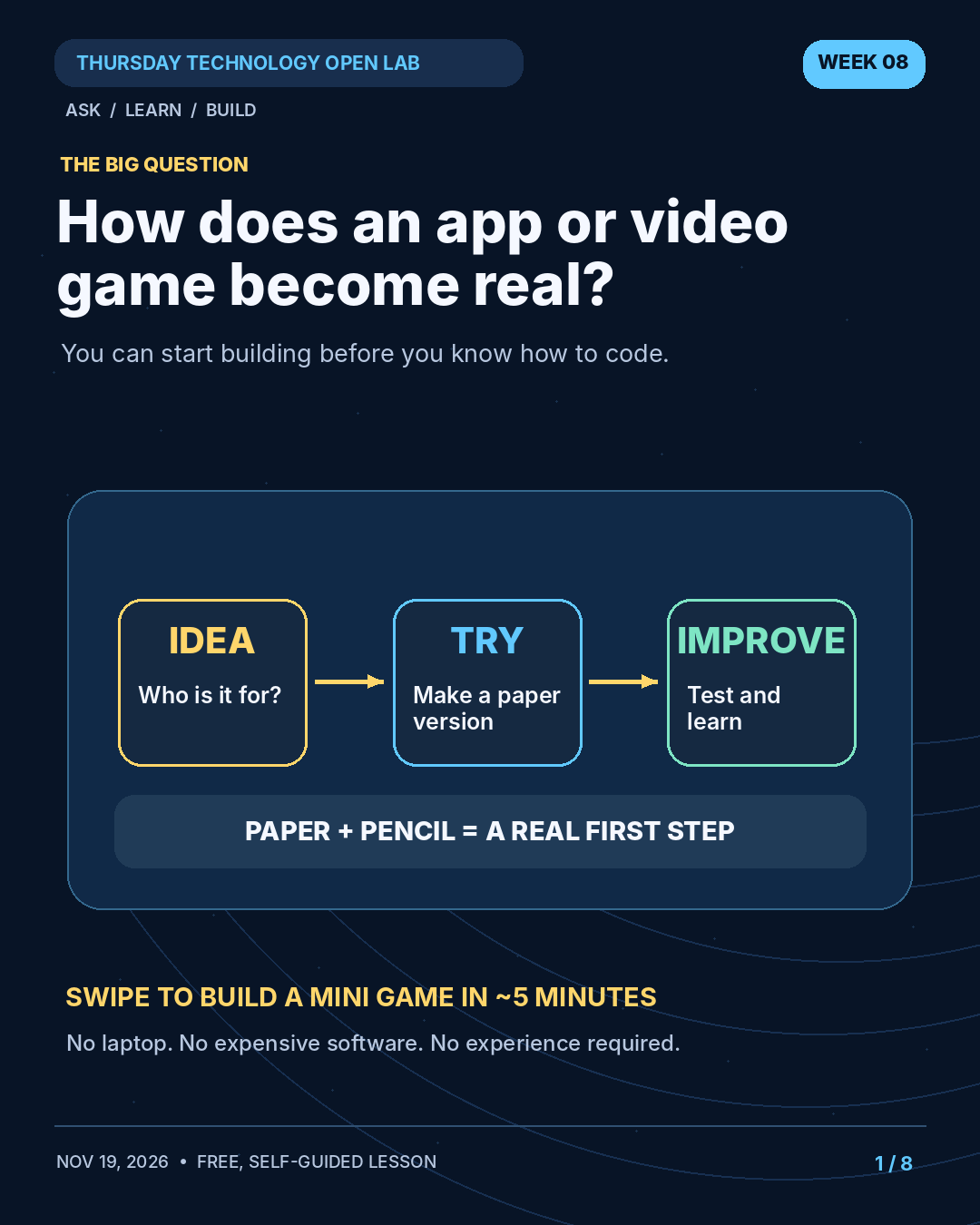
How an idea becomes an interaction
Start with someone who has a goal. Sketch how they might reach it, make a paper prototype, and watch someone try it. Use what you observe to improve the design, then share what you learned. A test can send you back to an earlier step.
Five building blocks of interactivity
- Input
- What action did the person take?
- Rule
- What should happen when they take that action?
- State
- What does the app or game remember, such as the current round or score?
- Output
- What changes on screen or paper?
- Feedback
- How does the person know what happened?
In Signal Sprint, choosing Collect is an input. The rule adds one point for a star. The score is state, and the updated score on screen is an output that gives the player feedback.
Play Signal Sprint on paper
Start with zero points. Draw a star, a cloud, and a star, in that order. On each turn, choose Collect or Skip and write down the score. Try to finish with at least two points after three turns.
- Collect a star to gain one point. Collect a cloud to lose one point.
- Skip either card to keep the same score.
Reveal the worked playthrough
| Turn | Card | Choice | Score |
|---|---|---|---|
| 1 | Star | Collect | 1 |
| 2 | Cloud | Skip | 1 |
| 3 | Star | Collect | 2 |
Prototype an app or game on paper
- Choose someone your app or game will serve. Write what they want to do, what action they will take, and what success looks like.
- Sketch three screens on paper. Show the goal on Start, a choice on Action, and what changed on Result.
- Write one rule for a choice. Record what the prototype remembers before the choice, what changes afterward, and how the person finds out.
- Try a normal action and an unexpected action. Write the expected and observed results for each test.
- Use your observations to improve one thing and test it again. If you can, watch someone else try your prototype and ask where they got confused.
Open the four-page printable worksheet and compare your approach with the worked example on page 4.
What confused your first tester? What did you change after seeing what happened? A public release also needs work on accessibility, privacy, reliability, testing, and support.
Choose your lane
Each lane is a depth you can choose. None of them is worth more than the others. You can participate without a computer. A paper drawing is valid. A phone photo can be used later, when submissions open.
Explorer
Describe who the experience is for and what they can do with it.
Week 8
- Name a user, a goal, and an action.
- Explain what should happen after that action and how the user will know.
- Explain the Signal Sprint rules in your own words.
Builder
Make a paper prototype and use the results of a test to improve it.
Week 8
- Sketch Start, Action, and Result screens, and write a rule for one choice.
- Compare what you expected with what you observed for a normal and unexpected action.
- Change one part of the design and run the test again.
Engineer / Researcher
Define how the prototype changes state and test how it handles unusual inputs.
Week 8
- Describe the states and the actions that move a user between them.
- Name a rule that must always hold, such as updating the score once per turn.
- Try an unexpected action, such as two rapid taps, and document the result you expect and the result you observe.
All 37 slides as text
Read the slide text in order or open the PDF for the original visuals.
Slide 1 · How Does an App or Video Game Become Real?
THURSDAY TECHNOLOGY OPEN LAB
WEEK 08 / START HERE
How Does an App or Video Game Become Real?
From a human idea to a working, testable experience — even with just paper.
THURSDAY TECHNOLOGY OPEN LAB • ASK / LEARN / BUILD
NOV 19, 2026
IDEA
DESIGN
A goal + rules
BUILD
A prototype
TEST
Evidence + changes
No programming required to complete this lesson. Bring your curiosity.
Slide 2 · Choose your depth, not your rank
THURSDAY TECHNOLOGY OPEN LAB
WEEK 08 / HOW TO USE
Choose your depth, not your rank
Anyone can follow along alone, with a friend, in the room, or on a replay.
THURSDAY TECHNOLOGY OPEN LAB • ASK / LEARN / BUILD
NOV 19, 2026
EXPLORER
Understand how an idea becomes a screen, an action, and a result. Use everyday language.
BUILDER
Make three screens, write rules, then let someone test your paper prototype.
ENGINEER / RESEARCHER
Define states, edge cases, invariants, performance needs, and evidence of correctness.
SUCCESS = an answer, an artifact, a next step, or a better question
Slide 3 · Seven weeks led us here
THURSDAY TECHNOLOGY OPEN LAB
WEEK 08 / CONNECTED COURSE
Seven weeks led us here
You already know more of the app-building story than you might think.
THURSDAY TECHNOLOGY OPEN LAB • ASK / LEARN / BUILD
NOV 19, 2026
01
W1: A technology experience is a system
02
W2: One tap becomes an event and response
03
W3: Speed and reliability change how it feels
04
W4: Hardware and operating systems do the work
05
W5: Networks connect local and remote components
06
W6: AI is one possible tool inside an experience
07
W7: Security protects people and information
Slide 4 · A useful app feels simple. Building it takes decisions.
THURSDAY TECHNOLOGY OPEN LAB
WEEK 08 / FAMILIAR MOMENT
A useful app feels simple. Building it takes decisions.
Imagine an app that helps a community member find the next technology workshop.
THURSDAY TECHNOLOGY OPEN LAB • ASK / LEARN / BUILD
NOV 19, 2026
WHAT THE PERSON SEES
“Find Thursday’s session.”
One clear button.
A useful answer.
A way to ask for help.
WHAT THE TEAM DESIGNS
Audience and purpose.
Information and rules.
Screens, inputs, data.
Accessibility, privacy, tests.
Slide 5 · The making process is a loop, not a straight line
THURSDAY TECHNOLOGY OPEN LAB
WEEK 08 / CREATIVE LOOP
The making process is a loop, not a straight line
An idea becomes stronger when real users try it and you learn from them.
THURSDAY TECHNOLOGY OPEN LAB • ASK / LEARN / BUILD
NOV 19, 2026
01
DISCOVER
02
DESIGN
03
PROTOTYPE
04
TEST
05
IMPROVE
06
SHARE
Return to an earlier step whenever evidence shows something needs to change.
Slide 6 · Apps and games share the same building blocks
THURSDAY TECHNOLOGY OPEN LAB
WEEK 08 / APP VS GAME
Apps and games share the same building blocks
Their goals can differ, but both translate human actions into software behavior.
THURSDAY TECHNOLOGY OPEN LAB • ASK / LEARN / BUILD
NOV 19, 2026
APP EXAMPLE
A library finder helps someone locate a book, check availability, or request help.
Success: the person completes a useful task.
GAME EXAMPLE
A tiny “Signal Sprint” game asks a player to collect stars while avoiding clouds.
Success: the player understands the rules and can play.
Both need: inputs • rules • state • outputs • feedback • tests
Slide 7 · Before code: Who is this for?
THURSDAY TECHNOLOGY OPEN LAB
WEEK 08 / START WITH PEOPLE
Before code: Who is this for?
The best first question is not “Which programming language?”
THURSDAY TECHNOLOGY OPEN LAB • ASK / LEARN / BUILD
NOV 19, 2026
PERSON
Who will use it? What experience, access, and devices might they have?
NEED
What problem are they trying to solve, or what experience do they want?
RESULT
How could we tell they successfully accomplished their goal?
Slide 8 · Describe the experience in one sentence
THURSDAY TECHNOLOGY OPEN LAB
WEEK 08 / WRITE A USER STORY
Describe the experience in one sentence
A user story is a starting conversation, not a complete specification.
THURSDAY TECHNOLOGY OPEN LAB • ASK / LEARN / BUILD
NOV 19, 2026
AS A [person], I WANT TO [action], SO THAT [benefit].
Example: As a learner, I want to find a free workshop so I can attend confidently.
Slide 9 · Five pieces make something interactive
THURSDAY TECHNOLOGY OPEN LAB
WEEK 08 / FIVE INGREDIENTS
Five pieces make something interactive
These ideas exist in websites, apps, games, kiosks, and learning systems.
THURSDAY TECHNOLOGY OPEN LAB • ASK / LEARN / BUILD
NOV 19, 2026
01
INPUT
02
RULE
03
STATE
04
OUTPUT
05
FEEDBACK
Example: TAP “PLAY” → apply rules → change playing status → show video → show response
Slide 10 · State means what the experience remembers
THURSDAY TECHNOLOGY OPEN LAB
WEEK 08 / UNDERSTAND STATE
State means what the experience remembers
A rule uses inputs and state to decide what happens next.
THURSDAY TECHNOLOGY OPEN LAB • ASK / LEARN / BUILD
NOV 19, 2026
BEFORE
Score: 0
Round: 1
Card: STAR
Choice: not yet made
AFTER “COLLECT”
Score: 1
Round: 2
Card: CLOUD
Message: “+1 star!”
Slide 11 · The person and the system take turns
THURSDAY TECHNOLOGY OPEN LAB
WEEK 08 / INTERACTION LOOP
The person and the system take turns
Interactive experiences repeat this loop until a goal or stopping condition occurs.
THURSDAY TECHNOLOGY OPEN LAB • ASK / LEARN / BUILD
NOV 19, 2026
01
SHOW
02
CHOOSE
03
UPDATE
04
RESPOND
REPEAT UNTIL FINISHED
Slide 12 · Meet Signal Sprint: a game you can play on paper
THURSDAY TECHNOLOGY OPEN LAB
WEEK 08 / WORKED EXAMPLE
Meet Signal Sprint: a game you can play on paper
Three turns. One decision each turn. Track your score without a computer.
THURSDAY TECHNOLOGY OPEN LAB • ASK / LEARN / BUILD
NOV 19, 2026
GOAL
Finish three turns with a score of at least 2 stars.
CHOICES
On each card: COLLECT or SKIP.
CARDS
We use a fixed sequence: STAR → CLOUD → STAR. No dice or secret choices.
Slide 13 · A fair game tells you exactly what choices do
THURSDAY TECHNOLOGY OPEN LAB
WEEK 08 / GAME RULES
A fair game tells you exactly what choices do
One consistent rule set makes the example playable and testable.
THURSDAY TECHNOLOGY OPEN LAB • ASK / LEARN / BUILD
NOV 19, 2026
01
Start with score = 0 and round = 1.
02
STAR + COLLECT → score increases by 1.
03
CLOUD + COLLECT → score decreases by 1.
04
SKIP → score stays the same (for either card).
05
After each choice, move to the next card.
06
After three rounds, score ≥ 2 means SUCCESS; otherwise TRY AGAIN.
Slide 14 · Three screens can hold an entire small experience
THURSDAY TECHNOLOGY OPEN LAB
WEEK 08 / MODEL THE STATES
Three screens can hold an entire small experience
A state diagram shows which screen or mode comes next.
THURSDAY TECHNOLOGY OPEN LAB • ASK / LEARN / BUILD
NOV 19, 2026
START
Show goal + Start button
PLAY
Show card, choice, score
RESULT
Show success/try again
REPLAY leads back to START
Slide 15 · Paper screens are real design tools
THURSDAY TECHNOLOGY OPEN LAB
WEEK 08 / SKETCH THE INTERFACE
Paper screens are real design tools
A prototype can reveal confusing choices before any code exists.
THURSDAY TECHNOLOGY OPEN LAB • ASK / LEARN / BUILD
NOV 19, 2026
START
Signal Sprint
Collect 2 stars
[ START ]
PLAY
Round 2 / 3
CLOUD Score: 1
[COLLECT] [SKIP]
RESULT
Final score: 2
SUCCESS!
[PLAY AGAIN]
Slide 16 · Rules become simple decisions
THURSDAY TECHNOLOGY OPEN LAB
WEEK 08 / LOGIC WITHOUT CODING
Rules become simple decisions
You can write the logic in everyday language before learning a programming language.
THURSDAY TECHNOLOGY OPEN LAB • ASK / LEARN / BUILD
NOV 19, 2026
WHEN a player chooses an action:
IF action is COLLECT and card is STAR: score = score + 1
IF action is COLLECT and card is CLOUD: score = score - 1
IF action is SKIP: score stays the same
THEN move to the next round
AFTER round 3: show success if score >= 2
Slide 17 · Art, sound, writing, and accessibility matter
THURSDAY TECHNOLOGY OPEN LAB
WEEK 08 / MORE THAN CODE
Art, sound, writing, and accessibility matter
A product feels usable because many kinds of decisions work together.
THURSDAY TECHNOLOGY OPEN LAB • ASK / LEARN / BUILD
NOV 19, 2026
EXPERIENCE
Clear text, understandable buttons, meaningful feedback, helpful instructions.
CREATIVE WORK
Characters, visuals, sounds, motion, narrative, and cohesive style.
INCLUSION
Readable contrast, captions, alternatives to sound, keyboard/touch paths, no color-only meaning.
Slide 18 · “Did it work?” is a design question
THURSDAY TECHNOLOGY OPEN LAB
WEEK 08 / FEEDBACK
“Did it work?” is a design question
Every action should make the result understandable, including errors and delays.
THURSDAY TECHNOLOGY OPEN LAB • ASK / LEARN / BUILD
NOV 19, 2026
UNCLEAR
You tap COLLECT.
Nothing changes.
You tap again.
Was the first tap recorded?
CLEAR
You tap COLLECT.
The score updates.
“+1 STAR” appears.
The next card is shown.
Slide 19 · A paper prototype proves an idea is understandable
THURSDAY TECHNOLOGY OPEN LAB
WEEK 08 / PROTOTYPE VS FINISHED
A paper prototype proves an idea is understandable
It does NOT prove a game or app is ready to ship.
THURSDAY TECHNOLOGY OPEN LAB • ASK / LEARN / BUILD
NOV 19, 2026
PROTOTYPE CAN TEST
Is the goal clear?
Can people make choices?
Are the rules coherent?
Can we observe confusion?
SHIPPING ALSO NEEDS
Working implementation.
Accessibility and privacy.
Robust failure handling.
Device and platform testing.
Ongoing maintenance.
Slide 20 · A test compares expected and observed behavior
THURSDAY TECHNOLOGY OPEN LAB
WEEK 08 / TESTING
A test compares expected and observed behavior
“It seems fine” is not evidence that a system works correctly.
THURSDAY TECHNOLOGY OPEN LAB • ASK / LEARN / BUILD
NOV 19, 2026
ACTION
What did the person do?
Example: Collect a STAR.
EXPECTED
What do our rules predict?
Example: 0 → 1 point.
OBSERVED
What actually happened?
Example: score changed to 1.
Slide 21 · Can we win by following the rules?
THURSDAY TECHNOLOGY OPEN LAB
WEEK 08 / NORMAL CASE
Can we win by following the rules?
Worked example using the public STAR → CLOUD → STAR sequence.
THURSDAY TECHNOLOGY OPEN LAB • ASK / LEARN / BUILD
NOV 19, 2026
ROUND
CARD
CHOICE
SCORE AFTER
Start
—
—
0
1
STAR
COLLECT
1
2
CLOUD
SKIP
1
3
STAR
COLLECT
2
Final score = 2 → SUCCESS
Slide 22 · What if the player does the unexpected?
THURSDAY TECHNOLOGY OPEN LAB
WEEK 08 / EDGE CASES
What if the player does the unexpected?
A robust design must decide how to respond at its boundaries.
THURSDAY TECHNOLOGY OPEN LAB • ASK / LEARN / BUILD
NOV 19, 2026
DOUBLE TAP
Should two rapid taps on COLLECT count once or twice? Decide and test.
NO SELECTION
What happens if someone waits or closes the game? Show an understandable state.
LOW SCORE
A score can become negative. Is that intended? If not, change the rule and test it.
Slide 23 · A bug is a mismatch worth investigating
THURSDAY TECHNOLOGY OPEN LAB
WEEK 08 / SPOT THE BUG
A bug is a mismatch worth investigating
If reality and the intended rule disagree, write down what you saw.
THURSDAY TECHNOLOGY OPEN LAB • ASK / LEARN / BUILD
NOV 19, 2026
EXPECTED: Score stays 1 after SKIP on a CLOUD.
OBSERVED: Score becomes 0.
Investigate the state update; do not rewrite the rule to hide the defect.
Slide 24 · Test with another person without coaching them
THURSDAY TECHNOLOGY OPEN LAB
WEEK 08 / LISTEN TO USERS
Test with another person without coaching them
Watch what they actually do, not what you hoped they would do.
THURSDAY TECHNOLOGY OPEN LAB • ASK / LEARN / BUILD
NOV 19, 2026
GIVE THE GOAL
“Try to win Signal Sprint.” Do not explain every button immediately.
OBSERVE
Notice hesitation, wrong turns, repeated taps, and unexpected interpretations.
ASK AFTER
“What did you think would happen?” “What felt confusing?”
Slide 25 · Improve ONE thing, then test again
THURSDAY TECHNOLOGY OPEN LAB
WEEK 08 / ITERATION
Improve ONE thing, then test again
Changing many things at once makes it hard to know what helped.
THURSDAY TECHNOLOGY OPEN LAB • ASK / LEARN / BUILD
NOV 19, 2026
BEFORE
Some players miss the score.
Hypothesis: the score is hard to find.
AFTER
Move the score near the choice buttons and make it larger.
Measure: can more testers notice it?
Slide 26 · One experience, more ways to participate
THURSDAY TECHNOLOGY OPEN LAB
WEEK 08 / ACCESSIBLE BY DESIGN
One experience, more ways to participate
Accessibility benefits learners with different devices, abilities, and environments.
THURSDAY TECHNOLOGY OPEN LAB • ASK / LEARN / BUILD
NOV 19, 2026
01
Write button labels; do not rely on color alone.
02
Ensure instructions can be read and understood.
03
Make targets large enough for touch or paper play.
04
Provide alternatives to audio-only clues and motion.
05
Allow time and clear progress feedback.
06
Test with people whose needs differ from yours.
Slide 27 · Do not collect what you do not need
THURSDAY TECHNOLOGY OPEN LAB
WEEK 08 / PRIVACY AND SAFETY
Do not collect what you do not need
A helpful app or game can be designed with privacy and safety from the beginning.
THURSDAY TECHNOLOGY OPEN LAB • ASK / LEARN / BUILD
NOV 19, 2026
GOOD DEFAULTS
Use fictional names in demos.
Ask only for needed information.
Protect saved work.
Make sharing understandable.
AVOID
Real passwords in class activities.
Unnecessary location tracking.
Publishing classmates’ data.
Unexplained permissions.
Slide 28 · A correct game can still feel wrong
THURSDAY TECHNOLOGY OPEN LAB
WEEK 08 / PERFORMANCE
A correct game can still feel wrong
Response time, frame timing, crashes, and connection quality shape enjoyment.
THURSDAY TECHNOLOGY OPEN LAB • ASK / LEARN / BUILD
NOV 19, 2026
RESPONSIVENESS
How quickly does an action show meaningful feedback?
RELIABILITY
What happens if the app closes or an operation fails?
CONSISTENCY
Does the experience work similarly across supported devices?
Slide 29 · Software creation includes many kinds of work
THURSDAY TECHNOLOGY OPEN LAB
WEEK 08 / TEAMWORK
Software creation includes many kinds of work
Different skills are needed even when one person takes multiple roles.
THURSDAY TECHNOLOGY OPEN LAB • ASK / LEARN / BUILD
NOV 19, 2026
DESIGN + CONTENT
Understand needs, sketch interactions, write instructions, create art and sound.
ENGINEERING
Implement behavior, manage data, devices, performance, and connections.
QUALITY + OPERATIONS
Test, document, release, support, maintain, and improve.
Slide 30 · How a real release reaches people
THURSDAY TECHNOLOGY OPEN LAB
WEEK 08 / BEYOND PROTOTYPE
How a real release reaches people
A public product needs evidence beyond one successful classroom test.
THURSDAY TECHNOLOGY OPEN LAB • ASK / LEARN / BUILD
NOV 19, 2026
01
PLAN
02
BUILD
03
VERIFY
04
RELEASE
05
SUPPORT
Store submission, rights, privacy, accessibility, platform rules, updates, and support require real work.
Slide 31 · Invent an idea in three sentences
THURSDAY TECHNOLOGY OPEN LAB
WEEK 08 / ACTIVITY STEP 1
Invent an idea in three sentences
You have everything needed: paper, pencil, and imagination.
THURSDAY TECHNOLOGY OPEN LAB • ASK / LEARN / BUILD
NOV 19, 2026
01
My user is ______________________________________
02
They want to ___________________________________
03
The experience succeeds when _____________________
Examples: a study timer • a community-event finder • a tiny collecting game
Slide 32 · Draw three screens and one interaction
THURSDAY TECHNOLOGY OPEN LAB
WEEK 08 / ACTIVITY STEP 2
Draw three screens and one interaction
Your screens can be boxes with words; they do not need polished art.
THURSDAY TECHNOLOGY OPEN LAB • ASK / LEARN / BUILD
NOV 19, 2026
START
What is the goal?
[BEGIN]
DO SOMETHING
What can I choose?
What changes?
RESULT
How did it go?
[RETRY / NEXT]
Slide 33 · Test it, and let the evidence speak
THURSDAY TECHNOLOGY OPEN LAB
WEEK 08 / ACTIVITY STEP 3
Test it, and let the evidence speak
Choose a normal action, an unexpected action, and one improvement.
THURSDAY TECHNOLOGY OPEN LAB • ASK / LEARN / BUILD
NOV 19, 2026
TEST 1
Normal action
Expected result? / Observed result?
TEST 2
Unexpected action
Expected result? / Observed result?
CHANGE
One improvement
What will change? / How will I retest?
You now have a design + prototype + test evidence.
Slide 34 · One complete playthrough of Signal Sprint
THURSDAY TECHNOLOGY OPEN LAB
WEEK 08 / WORKED ANSWER
One complete playthrough of Signal Sprint
A sample trace: STAR / COLLECT, CLOUD / SKIP, STAR / COLLECT.
THURSDAY TECHNOLOGY OPEN LAB • ASK / LEARN / BUILD
NOV 19, 2026
01
Before play: score = 0, round = 1.
02
Round 1: COLLECT STAR → score 1.
03
Round 2: SKIP CLOUD → score remains 1.
04
Round 3: COLLECT STAR → score 2.
05
Three rounds finished; 2 ≥ 2 → SUCCESS.
Other sequences are possible; their scores follow the same published rules.
Slide 35 · Engineering version: models, invariants, and failure paths
THURSDAY TECHNOLOGY OPEN LAB
WEEK 08 / DEEP CUT (OPTIONAL)
Engineering version: models, invariants, and failure paths
The same paper design can become a precise implementation plan.
THURSDAY TECHNOLOGY OPEN LAB • ASK / LEARN / BUILD
NOV 19, 2026
STATE MACHINE
Modes: START, PLAY, RESULT.
Transitions happen on explicit actions.
INVARIANTS
Exactly one card per round.
Exactly three completed rounds.
Score updates once per valid choice.
FAILURE HANDLING
Reject duplicate actions.
Preserve or reset state deliberately.
Make errors visible.
Slide 36 · From curiosity to creation
THURSDAY TECHNOLOGY OPEN LAB
WEEK 08 / NEXT STEPS
From curiosity to creation
Your paper prototype can become a project, portfolio artifact, or group discussion.
THURSDAY TECHNOLOGY OPEN LAB • ASK / LEARN / BUILD
NOV 19, 2026
KEEP THE ARTIFACT
Save your user story, three screens, rules, and test log. That is real design evidence.
KEEP EXPLORING
gunnchos.com/labs/thursday
WAIKE curriculum
The Technology Landscape
NEXT PUBLIC SESSION
DEC 3: Where Could I Fit in Technology?
No in-person Open Lab on Thanksgiving, Nov 26.
Bring a question. Bring a problem. Bring an idea. Or just bring your curiosity.
Slide 37 · Keep exploring after the session
THURSDAY TECHNOLOGY OPEN LAB
WEEK 08 / CONTINUE LEARNING
Keep exploring after the session
The public lesson and activity are free to revisit at your own pace.
THURSDAY TECHNOLOGY OPEN LAB • ASK / LEARN / BUILD
NOV 19, 2026
gunnchOS3k + OPEN LAB
Program home, public lessons, and the broader technology ecosystem.
gunnchos.com/labs/thursday
WAIKE CURRICULUM
Go from this activity to structured technology learning pathways.
github.com/gunnchOS3k/
waike-research-ops
THE TECHNOLOGY LANDSCAPE
Explore how people, systems, components, code, and networks fit together.
github.com/gunnchOS3k/
gunnchos-technology-landscape
Next public session
· Where Could I Fit in Technology?
The in-person lab takes a Thanksgiving break on .